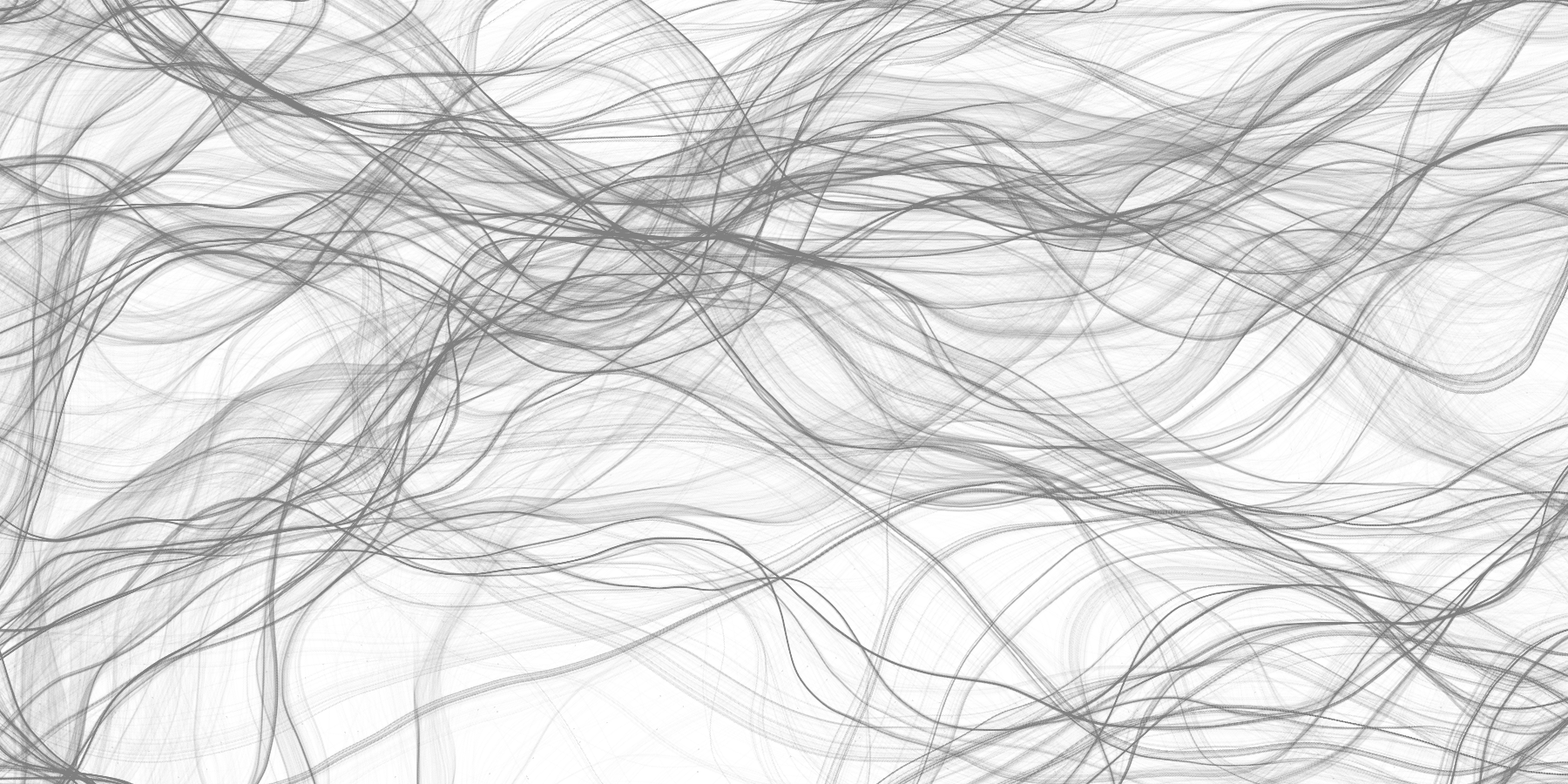
Hypokeimenon (Greek: ὑποκείμενον) is a term in metaphysics which means the "underlying thing" (Latin: subiectum). To search for Hypokeimenon is to search for the substance that persists in a thing going through change — its basic essence. This is a collection of projects using mathemathics and digital visualization to explore randomness and different patterns in randomness. The aim is to model Nature's underlying patterns.
A display of uniform distribution of randomness The dots appear at random x- and y-coordinates. The position of the individual dots are not related to the positions of other dots in the canvas
2
4
every object relates to the position of the other objects
Particle System
A particle system is a technique in game physics and motion graphics that uses many graphic objects to simulate certain kinds of "fuzzy" phenomena - usually highly chaotic systems, natural phenomena, or processes caused by chemical reactions. The system is defined as a group of points in space, guided by a collection of rules defining behavior and appearance. Particle systems can be used to replicate the phenomena of fire, explosions, smoke, moving water, sparks, falling leaves, clouds, fog, snow, dust, meteor tails, stars and galaxies, or abstract visual effects like glowing trails, magic spells and more.
3
4
non-uniform distribution of randomness
Perlin Noise 2D
Perlin noise is a type of gradient noise developed by Ken Perlin in 1983. It has many uses, including but not limited to: procedurally generating terrain, applying pseudo-random changes to a variable, and assisting in the creation of image textures. It is most commonly implemented in two, three, or four dimensions, but can be defined for any number of dimensions. Perlin noise in two dimensions generates a smooth randomness of numbers on the y-axis, where every y-position is related to both of the y-positions that come before and after. The second dimension is time
4
4
non-uniform distribution of randomness
Perlin Noise 3D
Perlin noise is a type of gradient noise developed by Ken Perlin in 1983. It has many uses, including but not limited to: procedurally generating terrain, applying pseudo-random changes to a variable, and assisting in the creation of image textures. It is most commonly implemented in two, three, or four dimensions, but can be defined for any number of dimensions. Perlin noise in three dimensions generates a smooth randomness of numbers on the x- and y-axis, where every x- and y-position is related to all the x- and y-positions around it on the two-dimensional plane. The third dimension is time